
Selling a St. Louis House in Fall or Winter, Answered
From 2026 St. Louis County-area closed sales and my own November 2023 listing. See the data ↓
Is it a bad idea to sell a house in St. Louis in the winter?
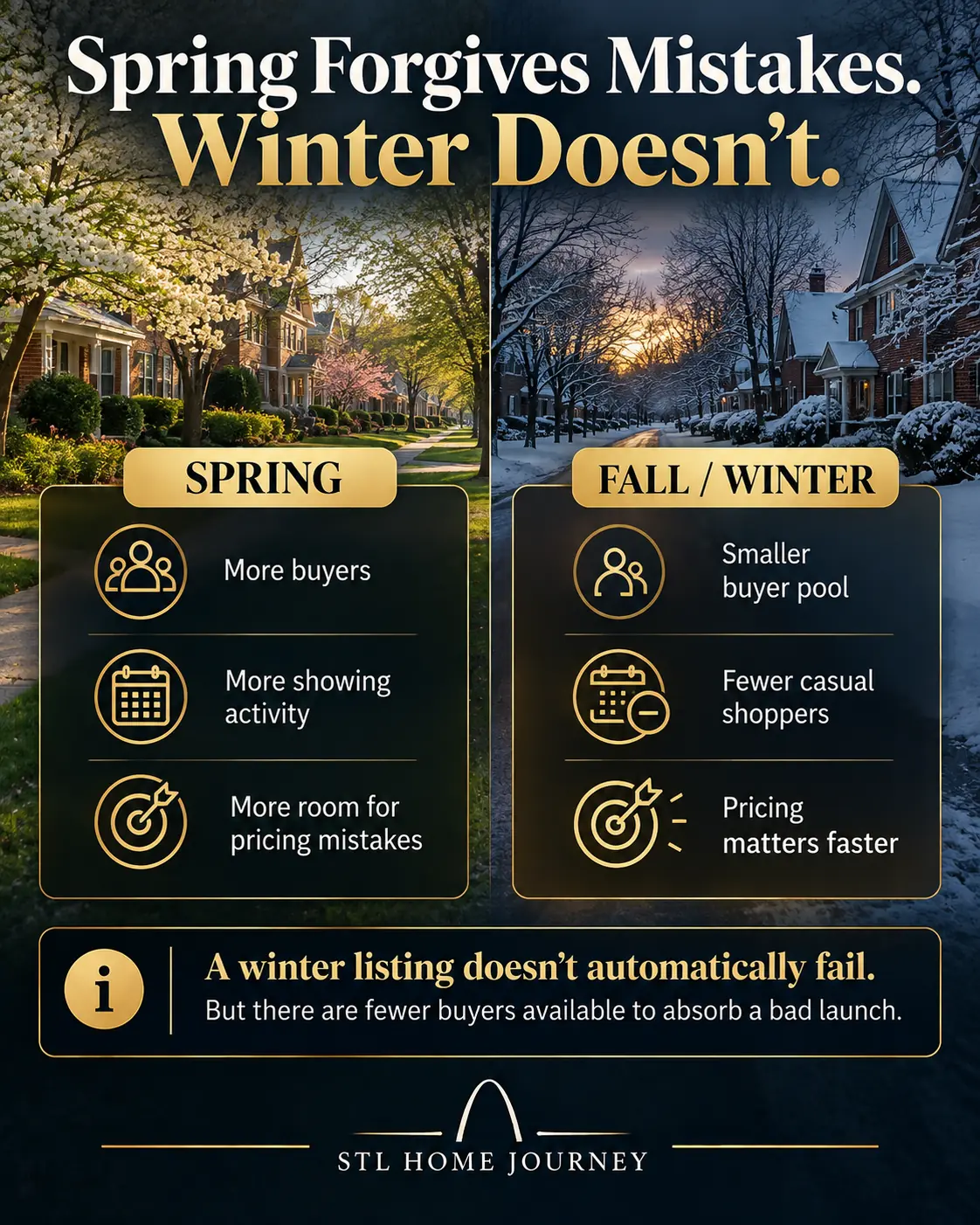
Not if you plan for it, but there’s less room for mistakes. In 2026 sales, a well-priced home and one that sat on the market ended up about 2 percentage points apart in spring, about 5 in August and September, and about 14 in January and February. Price, presentation and access decide whether a winter listing draws competition. How winter listings still sell ↓
How should I price a house to sell in the winter?
Price into the market buyers are shopping now. I start with the most similar homes that went under contract in the last couple of weeks, especially ones that drew multiple offers, and price near the point where buyers showed demand rather than at the top of the last sale. What “pricing into the market” means ↓
Can I use spring sale prices to set my winter list price?
Not by themselves. In 2026, sellers of homes that closed in August and September listed about 8% higher than sellers of comparable homes that closed in January and February. A quarter of those sales needed a price cut, typically about 7%. Homes priced right spent a median of 3 days on market and sold about 4% above comparable homes; homes that sat 60 days or more finished about 1% below. See the 2026 numbers ↓
Can a house sell fast and over asking in the winter?
It can. 982 Winter Park Drive in Fenton went active November 7, 2023, with mortgage rates near 7%, listed at $295,000 against comparable values at or above $300,000. Three buyers wrote offers, it sold for $302,000, went pending November 13 and closed December 4. That isn’t a promise every house will do the same. Read the Winter Park case study ↓
Do the holidays affect when I should list?
Yes. I try to time a launch so a buyer can get under contract before Thanksgiving and close before Christmas, as Winter Park did. Asking a buyer to start the whole process the week before a holiday leaves much less room. Why the holiday window matters ↓
Before You List: What Will Stop a Winter Buyer?
In the winter, we don’t have as many buyers to waste.
That’s why my first step happens before your house ever hits the market.
I’ll walk the property with you.
I’ve shown, toured, walked through open houses and viewed more than 3,000 homes with buyers over my career.
I’ve watched buyers react to houses in real time. I’ve heard the conversations in the car afterward. I’ve seen what buyers overlook, what makes them hesitate and what becomes a roadblock to an offer.
That experience helps me walk into your house and look at it differently.
I’m not there to hand you a giant list of projects. I’m certainly not going to tell you to spend $30,000 fixing things simply because HGTV says buyers like them.
I want to identify the things that could actually interfere with our sale.
Then we make an economic decision:
Which problems should we solve? Which should we price around? And which ones aren’t worth your money at all?
The goal isn’t to make your house perfect. It’s to remove as many unnecessary reasons as possible for a winter buyer to say no.
Your First Job Isn’t Selling the House—It’s Earning the Showing
Before we can sell your house, we need someone to walk through the front door.
That means your house needs to be clean, organized and ready to photograph.
Because the buyer’s first comparison probably isn’t happening in your living room.
It’s happening on their phone.
They’re looking at your house alongside every other house they could go see. Your photographs, presentation and price have one immediate job:
Earn the showing.
We don’t need buyers to fall in love with your house from a photograph. We need them to stop scrolling long enough to think:
“I need to go see that one.”
That’s especially important in winter. When fewer buyers are shopping, I don’t want to lose one because we couldn’t convince them to walk through the door.
Why Your Spring Comps Can Get Your Winter Price Wrong
This might be the most important part.
One of the biggest mistakes you can make in winter is pricing your house based entirely on what similar homes sold for during the spring.
Because you need to understand something:
Our buyer pool is different now.
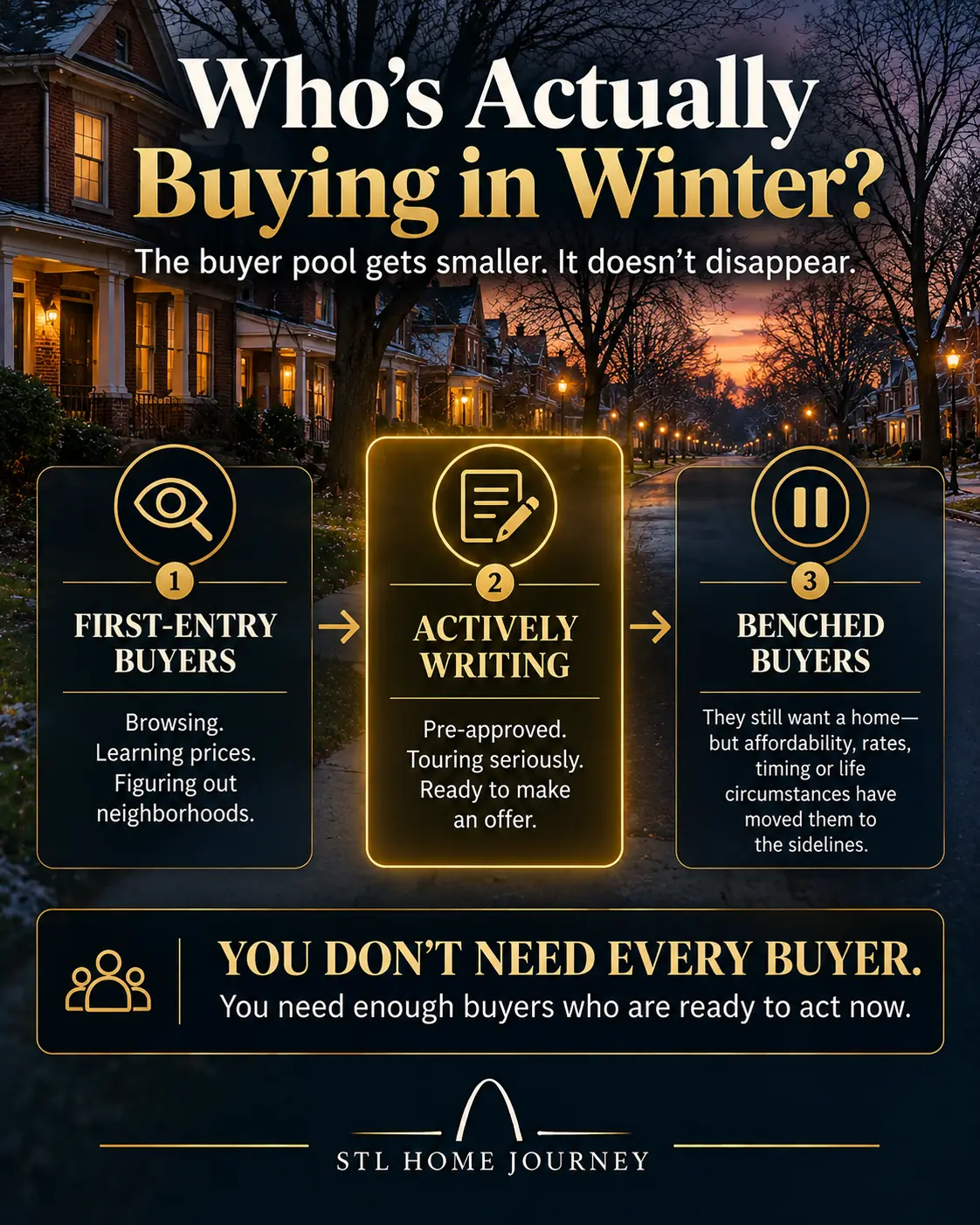
I tend to think about buyers in three groups.
First-Entry Buyers
These are buyers entering the market and still learning. They’re learning prices. They’re learning neighborhoods. They’re figuring out financing, inspections and what they actually want.
A showing from a first-entry buyer doesn’t necessarily mean they’re ready to write an offer tomorrow.
Actively Writing Buyers
These are the buyers I especially want at launch.
They’ve been looking. They understand the inventory. They’ve toured houses. Some have already written offers. Some have lost houses. They’re no longer learning how to shop.
They’re shopping.
Benched Buyers
These buyers haven’t necessarily left the market. They’ve stepped back.
Maybe they got tired of competing. Maybe they lost several offers. Maybe nothing has seemed worth writing on. Maybe they’re waiting for the right opportunity to pull them back in.
By fall and winter, we’re dealing with buyers who may have spent months watching this market. Some are extremely educated about what they’re seeing. Some have already lost houses they wanted. And some are simply exhausted.
This year’s numbers fit that. Buyers in August and September paid nearly what summer buyers paid for the same kind of house. What they wouldn’t do was chase a stretched list price.
They’re serious, but they’re not necessarily going to behave like an April buyer.
That’s why we can’t blindly take a spring sale and say:
“That house sold for $415,000, so ours should be worth $420,000 now.”
That’s not how I want to price your house.
What Does “Pricing Into the Market” Actually Mean?
I want to know where buyers have recently demonstrated demand.
We’re going to look for homes that are as similar to yours as possible. Ideally, I want one that went under contract recently—within the last couple of weeks if the right comparison exists.
I’m particularly interested in homes that generated competition and ultimately sold above their asking price.
Here’s why.
Suppose a nearly identical house was listed for $400,000. Multiple buyers wrote offers. One buyer ultimately paid $415,000.
Most people look at that transaction and see a $415,000 comparable.
I see something else too.
I see evidence of buyer demand around a $400,000 entry point.

One buyer got the house. The others didn’t.
Some losing buyers may have offered below asking. Some may have offered asking price. Others may have offered above asking and still lost.
I don’t need to know every losing offer to recognize what happened: multiple buyers decided that a house like yours was worth pursuing, and only one of them got it.
If that sale happened recently enough, some of those buyers may still be looking.
Those are exactly the buyers I want to reach.
We’re not automatically pricing your house based on what the winning buyer paid. We’re studying the price that brought buyers through the door in the first place.
The Appreciation Trap: Why May’s Sale Price Isn’t November’s Price
This is where a lot of sellers—and agents—get caught.
Consumers have been taught to think about appreciation like this:
A house sold for $415,000 in May. Home prices have appreciated. Therefore that house should be worth at least $415,000 in November.
Real estate doesn’t work in a perfectly straight line.
Housing markets are seasonal.
The price buyers were willing to fight over during peak spring demand isn’t automatically the price today’s buyer will pay during a different part of the market cycle.
You can see it in this year’s numbers. Across 22 St. Louis County-area school districts, showings per home peaked in March. Among 2,868 qualifying home sales there, the median sale price peaked in June at $379,500. By September it was $302,750—and even per square foot, prices had slipped from $189 to $174. See the month-by-month charts →
If that nearly identical house listed at $400,000 and competition pushed the final price to $415,000, I don’t automatically want to start your listing at $415,000.
That $15,000 difference may tell us something important about the competition surrounding that house.
The final sale price tells us what the winning buyer was willing to do. The original asking price helps us understand where the competition started.
That’s the trap. If we chase the spring winner instead of understanding why multiple buyers showed up in the first place, we can price ourselves away from the very buyers we’re trying to attract.
Our goal isn’t necessarily to recreate the previous seller’s final sale price.
Our goal is to recreate the buyer competition that helped produce it.
What Happened When Sellers Chased the Summer in 2026
I ran this year’s St. Louis County-area sales to see how this actually played out. Each sale was compared with homes like it: same school district, similar size, the same bedrooms and bathrooms, similar age and style.
For homes that closed in August and September, sellers had set their original list price about 8% higher than sellers of comparable homes that closed in January and February. That was the biggest jump of the year. Buyers didn’t follow. A quarter of those sales needed a price cut, and the typical cut was about 7%, the largest of any season.
| Priced right (under contract within 10 days) | Sat 60+ days | |
|---|---|---|
| Original list price vs. comparable homes | About even | About 11% higher |
| Sale price vs. comparable homes | About 4% higher | About 1% lower |
| Median days on market | 3 | 86 |
The homes priced right sold for about 4% more than comparable homes that closed in the same months. The ones that sat started well above them, cut their price, and finished slightly below them almost three months later. On a $350,000 house, that gap is roughly $17,000, plus three months of mortgage, taxes, insurance and utilities.
And that’s only the recorded sale price. It doesn’t show the whole deal. In my experience, homes that sat and cut their price are also the ones where buyers push hardest at inspection: help with closing costs, repair credits, or a seller fixing items before closing. The recorded price evens out. The seller’s net often doesn’t.
The season mattered less than the price. In this year’s sales, a well-priced home sold for about the same as a comparable well-priced home in any season. What changed by season was how hard the market punished the wrong price.
Winter is no different for the right listing. Even in January and February, homes that went under contract within 10 days sold at or above their original list price 78% of the time.
Based on 2,775 qualifying 2026 single-family sales in 22 St. Louis County-area school districts with complete house details (MARIS MLS). Recorded sale prices, before any seller concessions or repair credits.
How $5,000 Helped Bring Three Buyers to One Fenton Home
Let me give you a real example.
In 2023, I listed 982 Winter Park Drive in Fenton, Missouri.
This wasn’t a spring listing. The home went active November 7, 2023. Mortgage rates were hovering around 7%. Other comparable homes had demonstrated values at or above $300,000.
We listed Winter Park at:
$295,000.
Why?
Because I didn’t want one buyer to agree that the house was worth $300,000.
I wanted multiple buyers to believe it was worth more than $295,000.
MLS price entry: 10/30/2023 · Active: 11/07/2023 · George Kindler, listing agent
We received three offers.
Those buyers ultimately pushed the sale price to $302,000.
That’s what I mean when I talk about pricing into the market.
Listing at $295,000 didn’t mean we believed the house was only worth $295,000. We were trying to create a value proposition buyers would recognize.
And it worked.
Sometimes $5,000 can be the difference between waiting for one offer and creating the conditions where multiple buyers decide they don’t want to lose the house.
It won’t happen every time. No pricing strategy can promise you multiple offers. But Winter Park demonstrates why I care so much about the price buyers see when the listing first appears—not simply the number another seller eventually received.

You’ve Created Urgency. Can Buyers Actually Get In?
Once we’ve locked in a price designed to drive competition while still helping you reach your goals, we need to remove another potential roadblock:
Getting into the house.
You still live there. You still have work. You may have children, pets and a life that doesn’t stop because there’s a sign in the yard.
Reasonable boundaries are completely fine. For example: maximum 30-minute showing windows. Two hours’ notice for same-day showings. Shorter notice whenever you can reasonably accommodate it.
What I don’t want is a four-, six- or 24-hour notice requirement unless there’s a legitimate reason we need it.
Because every additional restriction creates another opportunity to lose a showing.
And buyers are emotional.
I’ve watched this happen countless times. A buyer wants to see a house. We can’t get them in when they’re available. Then you hear:
“Well, I guess it wasn’t meant to be.”
As though some predetermined real-estate destiny decided they shouldn’t buy your house.
Usually nothing mystical happened. We just made it too difficult for them to get through the door.
And in winter, when our buyer pool is already smaller, that’s a roadblock I want to eliminate whenever possible.
Price Creates the Fear of Missing Out. Access Lets Buyers Act on It.
This is where price and availability start working together.
Think about the buyer who’s been shopping for months. They’ve seen the inventory. They know what houses like yours have been selling for. They may have already lost one.
Then your house appears.
The photographs look great. The house fits what they’ve been looking for. And the price immediately makes sense.
I want that buyer thinking:
“We need to see this before somebody else gets it.”
That’s the fear of missing out we’re trying to create.
Then I want us to make it incredibly easy for them to act on that feeling.
Can we see it tonight? Yes. Can we get in after work? Yes. Can we come tomorrow morning? Yes.
Within reasonable boundaries, I want that answer to be yes as often as we can make it yes.
Price gives buyers a reason to move. Availability lets them move. That’s how we take a smaller winter buyer pool and give ourselves the best opportunity to get those buyers through the door.

Why I Pay Attention to the Holiday Closing Window
Winter Park teaches us something else.
Timing matters.
The home went active November 7. It was pending by November 13. And it closed December 4.
Look at where that placed the transaction. The buyers could get through the opening stages of buying the house before Thanksgiving and complete their purchase after Thanksgiving but before Christmas.
That’s something I pay attention to when selling during the holidays.
There’s a difference between having a normal closing window that happens to land near a holiday and asking a buyer to start the entire home-buying process a week before Thanksgiving or Christmas.
The first one can give us more forgiveness. The second gives us much less.
Because now we’re asking someone to tour houses, write an offer, schedule an inspection, negotiate, work with their lender, coordinate an appraisal, think about moving—and do everything else involved with buying a house while they’re also traveling, hosting family, buying gifts or simply trying to enjoy their holiday.
Some buyers will absolutely do it. Others will say: “We’ll start looking again after the holidays.”
That’s why I don’t just ask: “What day should we put your house on the market?”
I work backward. If the right buyer writes an offer this weekend, when are we asking that buyer to close? That’s a much better question.
Winter Isn’t One Problem—It’s Five Problems at Once
This is why selling during winter requires more strategy.
We’re not fighting one external factor. We’re dealing with several at the same time.
A smaller buyer pool. Holidays interrupting schedules. Shorter daylight hours. Weather interfering with showings and presentation. Buyers who may already be exhausted from months of searching and losing homes.
And some buyers will simply decide to wait until spring.
We can’t control those things.
But we can control how many additional obstacles we create ourselves.
We control preparation. We control presentation. We control our initial pricing strategy. We control when we launch. We control how easy the house is to show. We control how quickly we respond when the market gives us information.
That’s where our opportunity comes from.
The First Weekend Tells Us Whether Our Strategy Worked
Once your house is active, I’m not interested in putting it online and waiting three weeks to see what happens.
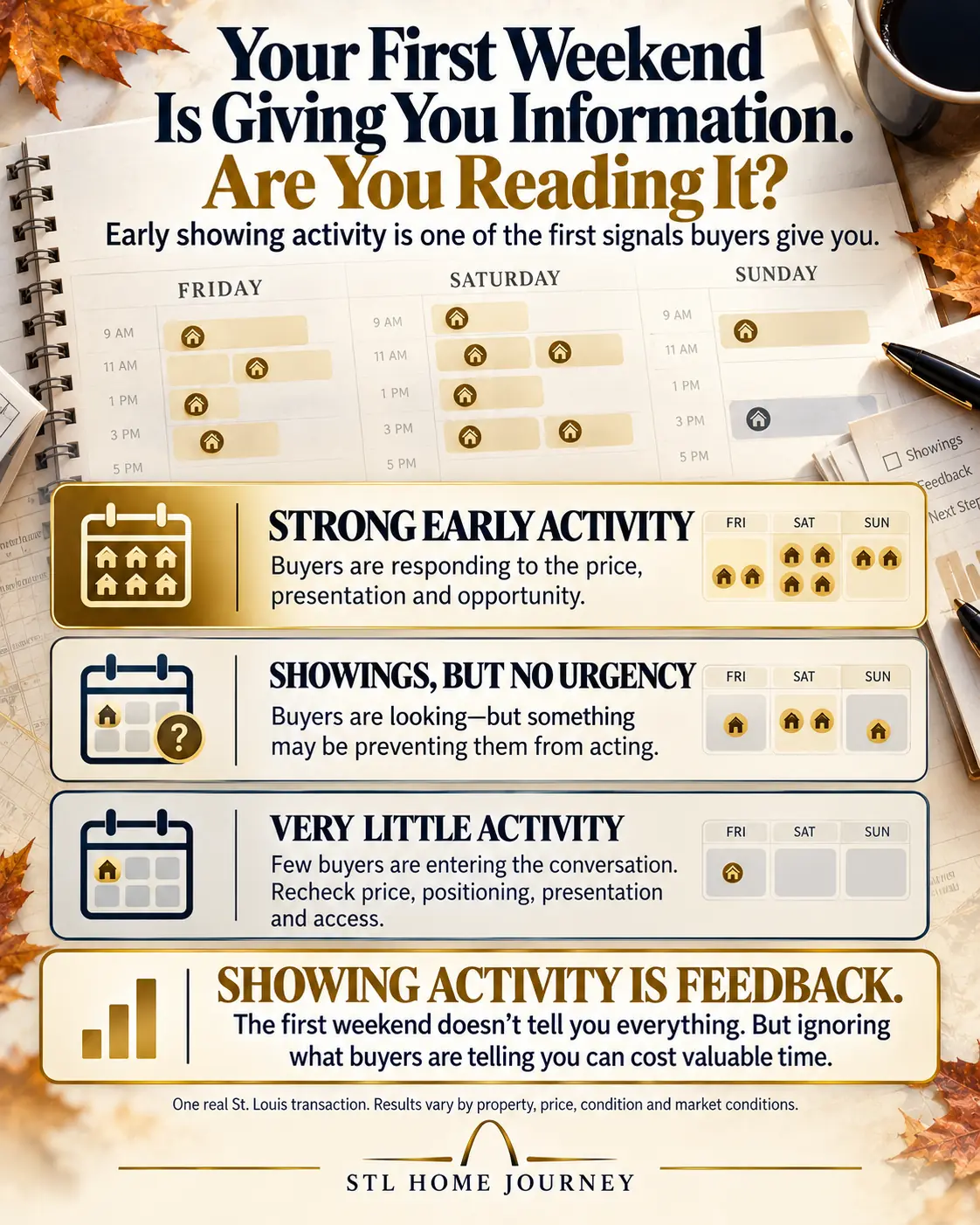
The first weekend gives us valuable information.
How quickly are showings being scheduled? How many buyers are actually coming through? Are buyers saving the property? Are agents asking questions? Are buyers coming back? Are we hearing questions about other offers? Are people writing?
Because showing count by itself doesn’t tell me enough.
Showing velocity matters.
Ten showings during the opening weekend tells me something very different than ten showings spread across three months.
Especially in winter.
We built a strategy designed to get the strongest available buyers through the door. Now we watch what they do.
If they respond, great. If they don’t, that’s evidence too. And I’d rather react to evidence while the listing is still fresh than spend weeks hoping the market eventually changes its mind.
So, Can You Actually Sell Your House This Winter?
I’ve just spent a lot of time explaining why selling during the fall and winter can be harder.
So here’s the good news:
We know what we’re up against.
We’re not putting your house on the market in December and hoping it behaves like April.
We know the buyer pool is smaller. We know the holidays interrupt the market. We know buyers may behave differently. And we know we have less room for mistakes.
That means we can plan for it.
We can walk the house and identify roadblocks before buyers find them. We can get it clean, organized and photographed properly. We can price into the market buyers are actually shopping in. We can launch when the calendar gives us the best opportunity. We can make the house incredibly easy to see. We can create a value proposition that makes an experienced buyer afraid somebody else might get there first.
And then we can watch how buyers respond and make decisions based on actual evidence.
Remember Winter Park.
That house didn’t need April.
It went active November 7. Three buyers wrote offers. It sold for $302,000 on a $295,000 asking price. And it closed December 4.
Winter didn’t prevent us from creating competition. It just meant we had to be more intentional about how we created it.
If You Have to Sell This Winter, Let’s Work With the Market You Actually Have
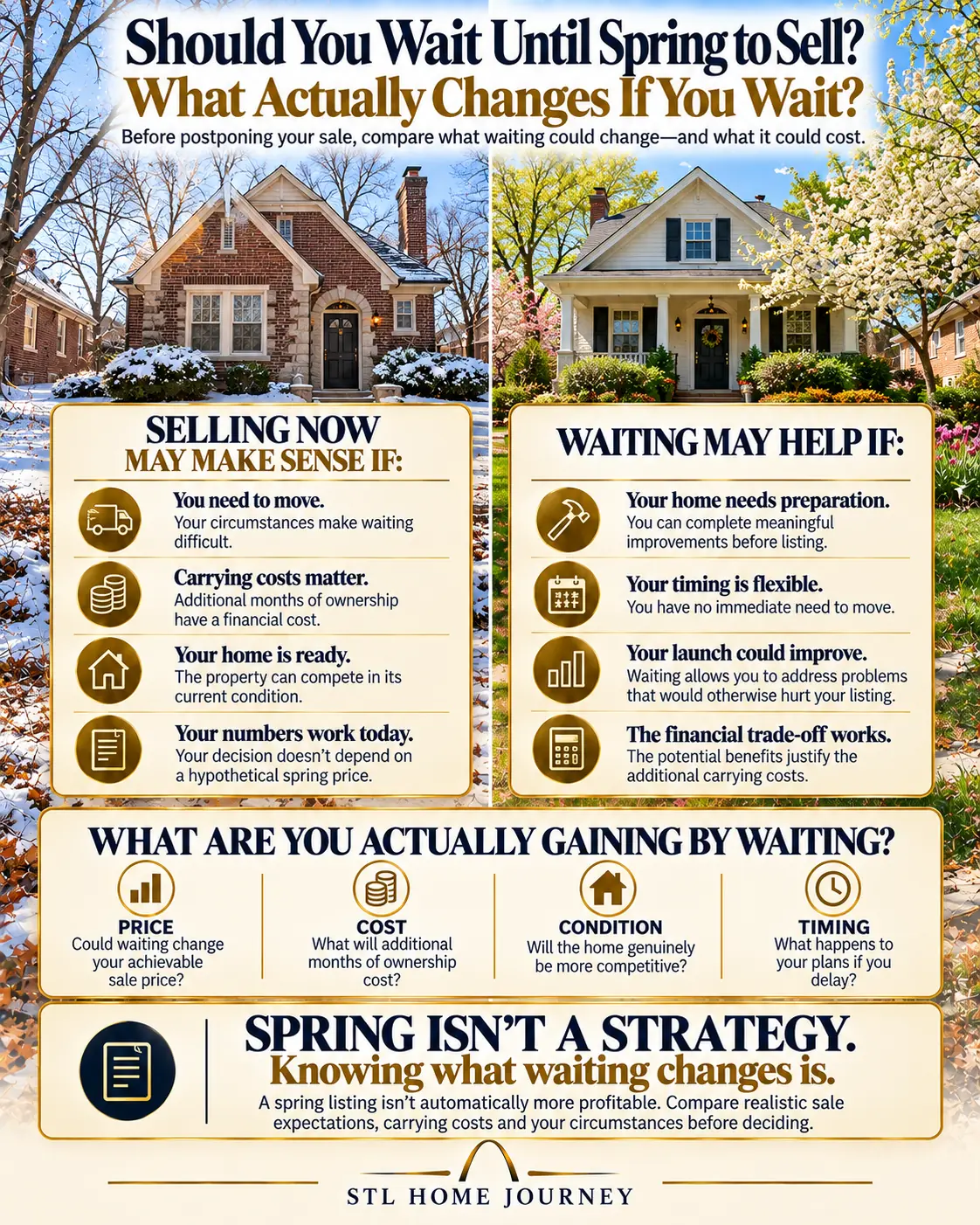
Maybe you would rather wait until spring. If your timeline allows it, that’s a conversation worth having.
But sometimes that’s not the situation.
Your family changed. You’re relocating. You’ve already bought another house. You’re dealing with an inherited property. Your previous listing didn’t sell. You’re downsizing. Or you simply need to move.
In that situation, telling you “spring is better” isn’t particularly helpful. You already know that.
The useful question is: What can we do with the market we have right now?
I’m not going to promise you that winter suddenly becomes spring. I’m not going to promise three offers because Winter Park received three offers. And I’m not going to tell you every house can sell for more than asking.
What I will do is help you understand the market you’re entering, identify the roadblocks before buyers encounter them and build the strongest strategy we reasonably can around your actual timeline.
If you have to sell this winter, I’m not going to tell you to wait six months for a better market.
I’m going to help you build the best possible sale in the market you actually have.
More Questions Sellers Ask About Fall and Winter
Before you list
What should I fix before listing a house in the winter?
Only what would stop a buyer. I walk the house first and decide, item by item, what to fix, what to price around and what isn’t worth the money. The goal is to remove unnecessary reasons for a winter buyer to say no, not to make the house perfect. What stops a winter buyer ↓
Why do listing photos matter more in the winter?
Because a buyer’s first comparison happens on their phone. A clean, organized, well-photographed listing earns the showing, and with fewer buyers shopping, every lost showing costs more. Earning the showing ↓
Who’s buying
Who is still buying houses in the fall and winter?
Three groups: first-entry buyers still learning the market, actively writing buyers who have toured homes and often lost offers, and benched buyers who stepped back after competing. Actively writing and benched buyers are the ones I want at launch. The three buyer groups ↓
Why is selling in the winter harder than in the spring?
It’s five problems at once: a smaller buyer pool, holidays interrupting schedules, shorter daylight, weather, and buyers worn out from months of searching. You can’t control those, but you control preparation, presentation, pricing, launch timing, access and how fast you respond. Five problems at once ↓
Showings and the first weekend
How much showing notice should a winter seller require?
As little as you reasonably can. Limits such as 30-minute showing windows and two hours’ notice for same-day showings are fine. Four-, six- or 24-hour notice requirements cost showings, and in winter you can’t afford to lose them. Making the house easy to see ↓
How do I know if my winter listing is priced right?
Watch the first weekend: how fast showings are booked, how many buyers come through, whether they save the listing, come back or ask about other offers. Ten showings in one weekend means something very different from ten spread across three months. What the first weekend tells you ↓ When to lower the price →
Timing
Should I wait until spring to sell my house?
If your timeline allows it, that’s worth discussing, because spring brings more buyers and more room for mistakes. If you’re relocating, carrying two houses, handling an inherited home or simply need to move, a winter plan built around your actual timeline is the useful answer. If you’re selling first and then buying, I usually suggest listing around February. Working with the market you have ↓ Buying and selling at the same time → Should you sell first or buy first? →
Ready to Talk About Your Timeline?
If you need to sell this fall or winter, I’ll walk your house, study the market and build the strategy around the timeline you actually have.

I’m not selling you a house. I’m showing you how to think about buying or selling a house.
The Closing Pros LLC
Licensed Missouri Real Estate Brokerage
Office: 314-998-4550 · George’s Direct Line: 314.435.1087
Winter Park case study facts are from George’s own 2023 transaction (MLS price entry 10/30/2023, active 11/07/2023, pending 11/13/2023, closed 12/04/2023). Buyer-pool framework reflects George’s operating methodology. Market conditions vary. No pricing strategy guarantees multiple offers. Always consult a licensed agent for professional guidance specific to your property and timeline.